


by Evi Mibelli.
When asked what architecture and design meant to him, he laconically replied, “There is no life without aesthetics,” a perfect synthesis of what should surround people’s daily lives.
It is only beauty, the well-being generated by the harmony between the built environment and its surroundings, that makes human existence a worthwhile experience. A tension that is, ultimately, a spiritual quest. Vilhelm Lauritzen is universally recognized as the Master of Danish Modernism. A modernism, however, that distances itself from the cold formula " form follows function ." There is much more.
An unconditional love for Nature is her primary source of inspiration. It's not, therefore, a rational and abstract exercise in mathematical and geometric proportions. No, Lauritzen embodies the emotion of simplicity , and she does so in a stunning way.
The VLA61 Monarch chair from 1944. Only 10 were produced for an unfinished project. Reissued by Carl Hansen & Son in 2023.

He was born on September 9, 1894, in Slagelse, Denmark. He studied architecture at the Royal Danish Academy of Fine Arts in Copenhagen, graduating in 1921. The following year, in 1922, he opened his own studio, Vilhelm Lauritzen Arkitekter, where he continued to practice until 1969, when he retired.
His studio is still active today and represents one of the most important design realities in Denmark, as well as being an invaluable historical reference point (it has a perfectly preserved archive of its founder's immense production), so much so that in 2022 it promoted a commemoration for the centenary of its foundation, with the re-edition of some of Lauritzen's most iconic and representative design projects.
Radiohus Sofa, 1936. Reissued by Carl Hansen & Son in 2022.

In the late 1920s, he embarked on a journey through Central Europe, which introduced him to the Functionalism of the Bauhaus and its conceptual, technical, and structural innovations. He quickly applied its principles—albeit with surprising originality—as early as 1928, when he was commissioned to design the Daells Varhus, a department store, in Copenhagen. It was, in effect, the first example of modernist architecture in Denmark.
Vilhelm Lauritzen Terminal. Copenhagen Airport. Opened in 1939. Renovated in 1998. Photo © Rasmus Hjortshøj.

His architectural vision culminated in the design of the first terminal at Copenhagen Airport (following a competition), built between 1937 and 1939. No longer operational, the terminal was restored to its original layout in 1998 and is open to visitors. What is striking is its exceptional contemporaneity. And it is no coincidence that this space has, since its inauguration, served as a benchmark for all future airports.
It has become an essential paradigm for defining public transit spaces. The reference to the organic and to nature is evident in the use of soft lines, such as those that outline the Hall's roof, or in the twisting staircase that connects the ground floor to the traveler's balcony. If we were to venture into the realm of art, it feels like looking at a painting by Picasso or Braque.
His design language, then, masterfully engages with light (a constant throughout his architectural output). He masters natural—and artificial—light by opening immense windows facing south and west, combined with skylights that draw light from the north and east. The immaterial chromatic variability of light is a material that plays with surfaces, geometries, and volumes.
Main facade of the Radiohuset building in Frederiksberg. Original design from 1945. Photo © Rasmus Hjortshøj/Coast.

A fundamental tenet of his design philosophy is the vision that links architecture to interior design , extending to furnishings and accessories. It's a comprehensive approach . One need only recall the building constructed for the Danish National Radio—the Radiohuset in Frederiksberg (now the Royal Academy of Music)—in 1945, where an architecture designed to house recording, broadcasting, and concert halls (with cutting-edge acoustic engineering) is combined with furniture and furnishings of exceptional workmanship and beauty. And the detail extends right down to the design of the handles.
Concert hall and internal staircase. Radiohuset, original design from 1945. Photo © Rasmus Hjortshøj/Coast.

The Radiohus sofa , for example, is a pioneering piece of Nordic functionalism. Its distinctive feature is the almost total absence of straight lines, subverting the geometric rigor of academic functionalism. It's beautiful from every angle, perfect for being a cool protagonist in both public and domestic spaces.
The VL45 pendant lamp and VL38 floor lamp, produced by Louis Poulsen. Both were created as part of the Radiohuset project.

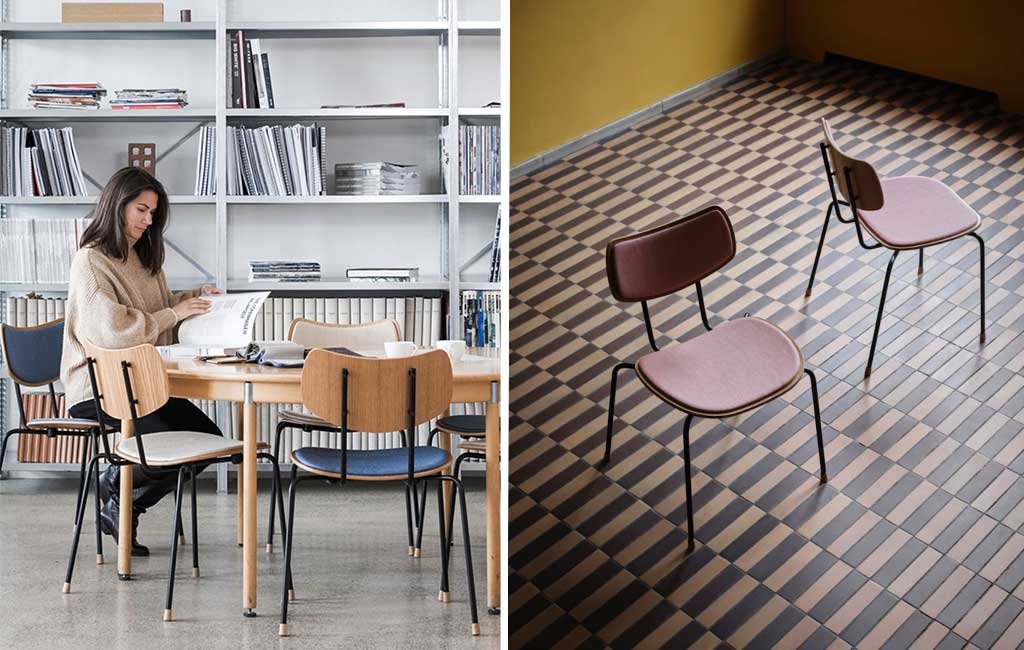
A similar situation occurred with the People's House/Vega Hus in Copenhagen , built between 1953 and 1956. The building contained small and large theater and cinema halls, as well as banquet halls. Here too, every single detail was designed by Lauritzen: the furnishings, the paneling, the accessories. Closed for several years, it was completely restored in 1996 and reopened as the Vega House of Music.
Vega Chair, 1956. Reissued by Carl Hansen & Son in 2022.
A proponent of the democratic nature of design—that is, beautiful and functional design should be accessible—his furnishings have been the subject of countless auctions for exorbitant prices. His desire to "give beauty" to everyone has long remained locked away in the studio's archives.
But for the centenary of its founding, Carl Hansen & Son , in collaboration with Vilhelm Lauritzen Architects , has reissued the most beautiful pieces by this genius of simplicity. Because it must be said: Vilhelm Lauritzen had that extraordinary ability to stay "one step behind," to avoid self-celebration. His design is a unique and unrepeatable gift. And therefore timeless. A milestone. He died at the age of 90, in 1984, in Copenhagen.
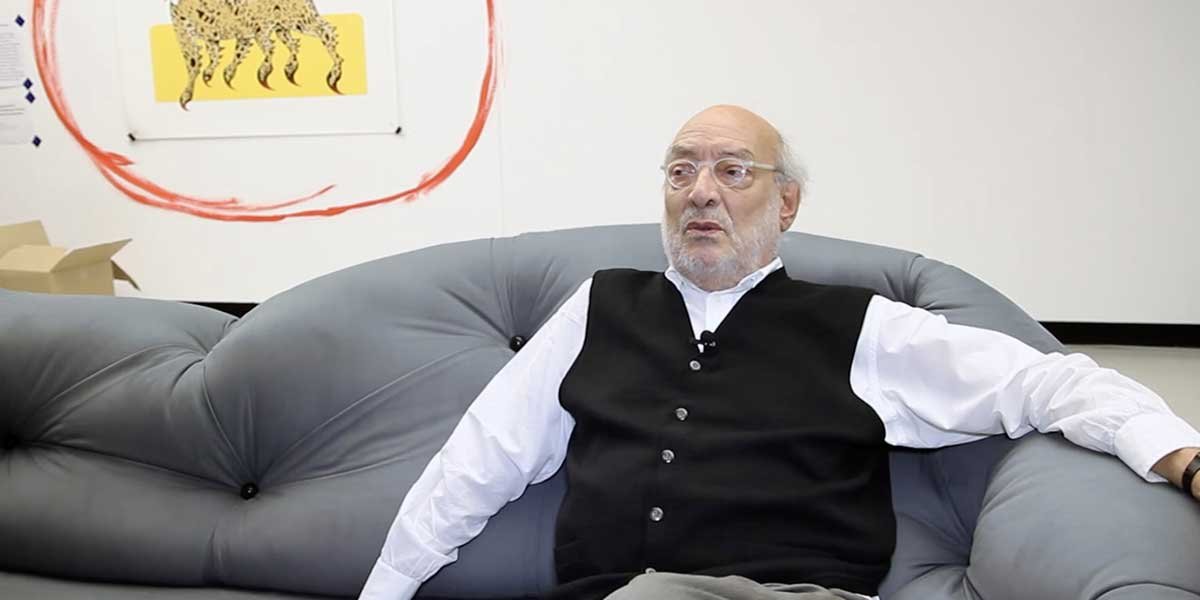
Vilhelm Lauritzen photographed inside the Danish Embassy in Washington DC, for which he curated the entire project in 1960.
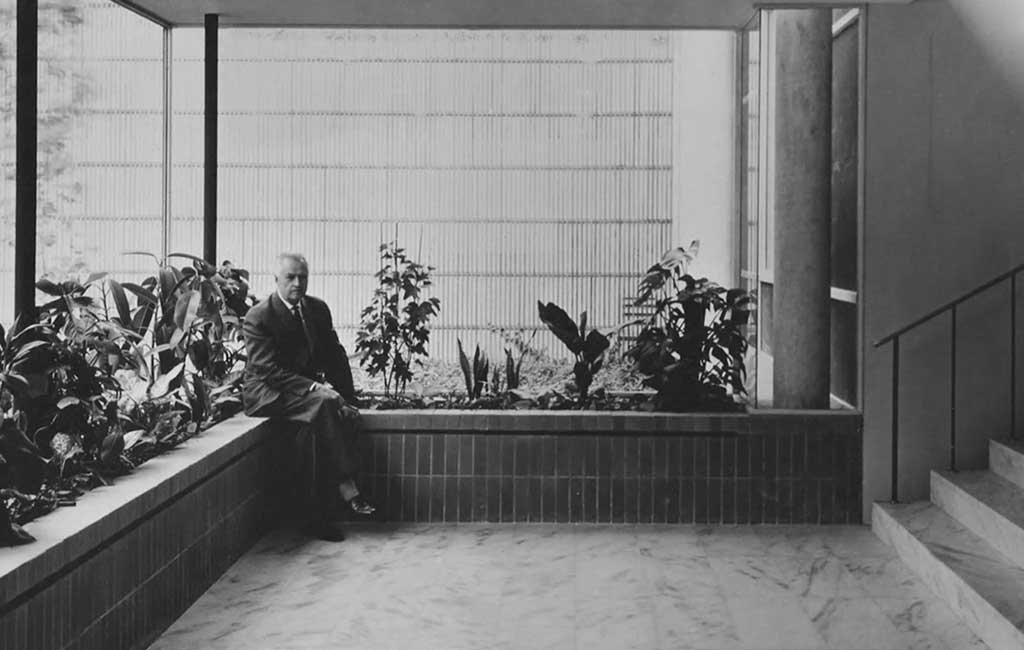
On the cover, Vilhelm Lauritzer. Photo © Vilhelm Lauritzen Architects archive.