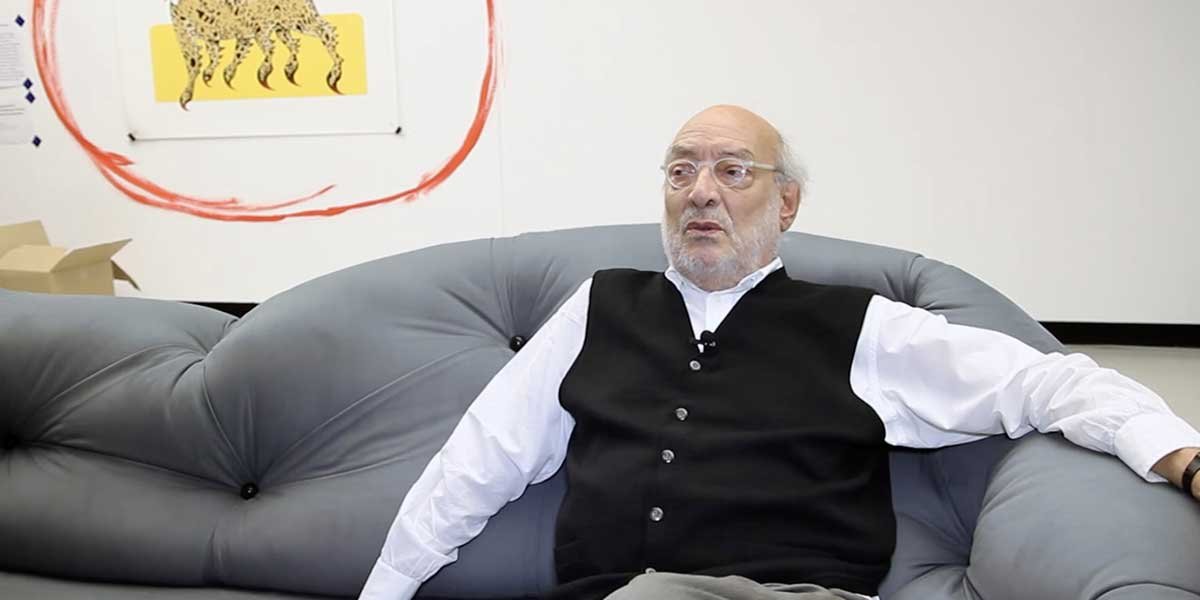




Ettore Sottsass , born in Innsbruck on September 14, 1917, was first and foremost an architect, but he will go down in history above all as one of the most brilliant industrial designers of the twentieth century . In 1947, he opened his studio in Milan and began collaborating with the most famous Italian companies, Olivetti first and foremost, a thirty-year partnership that soon yielded extraordinary results, such as the celebrated typewriter models Praxis, Lettera 36, and the Valentine, with its iconic red color, which became a symbol of pop design.
Valentine (1968).

An innovative and "transgressive" typewriter, it broke with the company's tradition and the very idea of a static, heavy object that remained on the office desk. The Valentine's key feature is its portability : a lightweight ABS plastic object that can be folded into a container whose lid and carrying handle are the back of the machine itself. An attractive product designed for a young, trendy audience, it could be used anywhere, "conceived as a new ballpoint pen, a low-cost object ready to be sold even in local markets," as the designer himself described it.
In 1959, again for Olivetti, he designed the Elea 9003, the first Italian calculator, which won the Compasso d'Oro . Also significant and unconventional was his collaboration with the Tuscan company Poltronova, where Sottsass became art director, allowing him to experiment with new forms, techniques, and proportions, such as the Superbox—monolithic furniture with large bases covered in optical laminate and featuring a wide variety of color combinations—and the Mobili Grigi collection, whose most famous piece is the Ultrafragola mirror, still in production today since 1970.
Superbox furniture (1966).

The Ultrafragola mirror (1970), a tribute to women and their disturbing vanity.

The name Sottsass is inextricably linked to the Memphis group (founded together with Hans Hollein, Arata Isozaky, Andrea Branzi, Michele de Lucchi), a design group born in the early 80s that marked an era and changed the face of contemporary furniture.
The principle behind the absurd and monumental furniture was emotion over function, a provocative response to the Modernist decor and bourgeois culture of the time. The colors , designs, bold shapes, and disparate combinations of Memphis objects were inspired by everyday subjects, pop culture, and non-European cultures.
Interior by Memphis.

The objects that have become the movement's manifesto and that best identify and describe this historical period are the Carlton bookcase , a mix between a totem and vaguely anthropomorphic forms, the Ashoka lamp, and the Tahiti lamp with its zoomorphic profile. It undoubtedly wrote an indelible chapter in the history of international design and architecture.
Carlton bookcase on the right (1981) and Ashoka lamp on the left (1981).

Sketches and Tahiti lamp (1981).