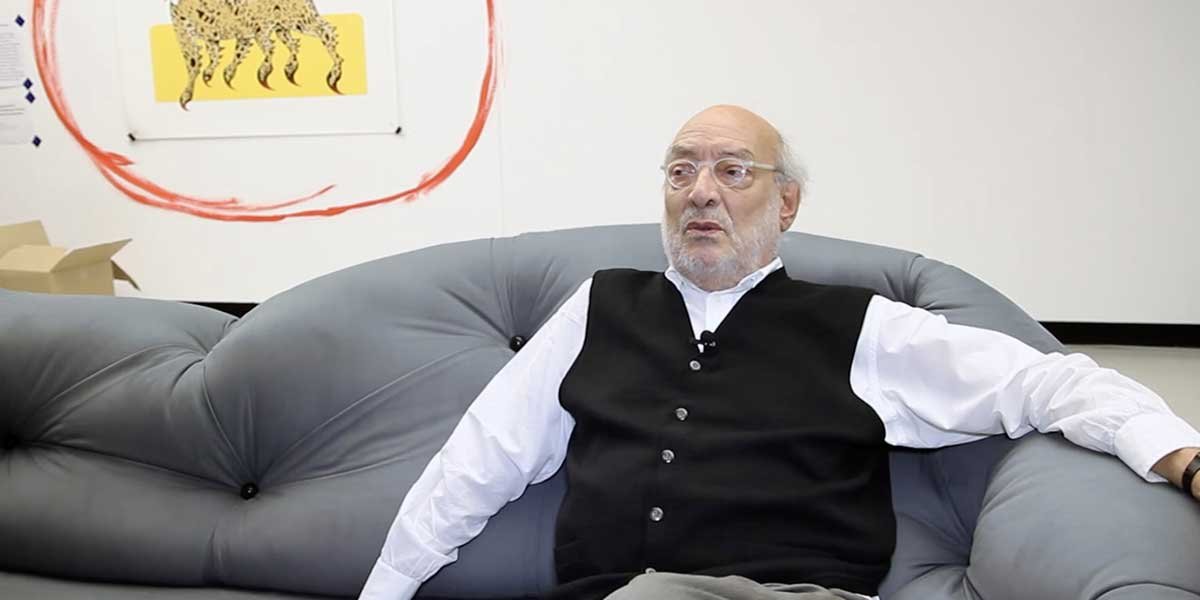



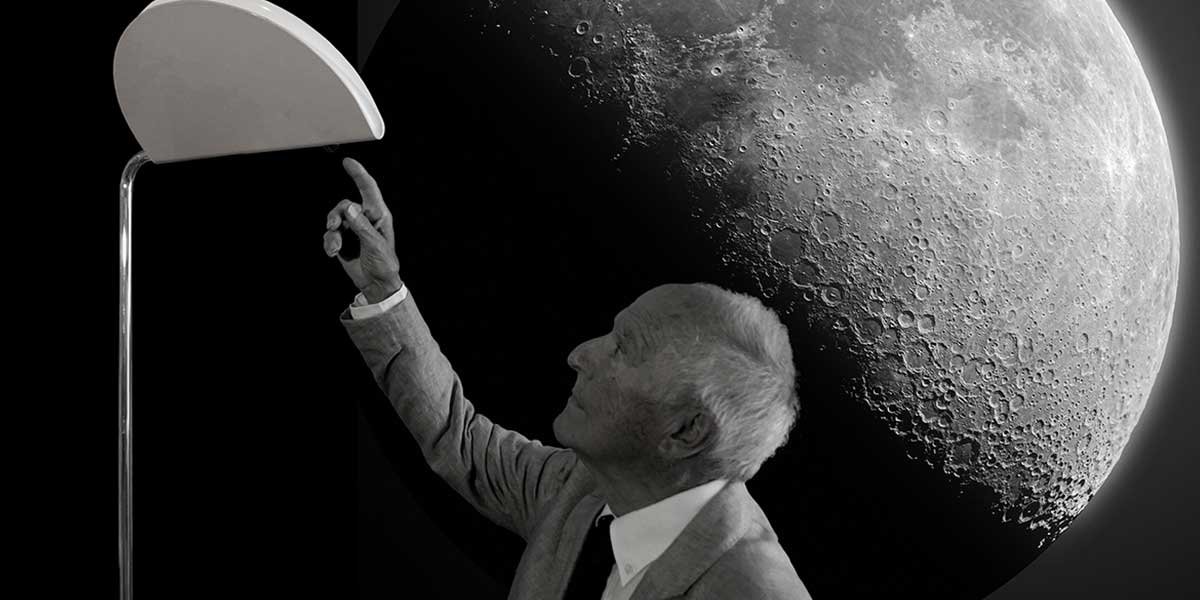
An interview by Evi Mibelli with Bruno Gecchelin.
“A well-designed object is not one that is immediately noticeable, but one that works well, lasts over time, and is a pleasure to use.”
It's difficult, in the space of an interview, to summarize the life and professional journey of a master like Bruno Gecchelin , who for sixty years, with an old-fashioned grace, has contributed to the best of Italian design. If it were just a matter of dates, milestones, and successful products, it wouldn't be so difficult. The desire, instead, is to intertwine his human dimension with that of a designer. It's to find that invisible thread between imagination, emotion, and concreteness that is, in effect, his expressive signature.
His face, posture, and tone of voice convey an unexpected enthusiasm, as if time had not diminished his youthful creative energy. Not only that. He has the ability to narrate design—his own—while always elegantly remaining in the background. It's a precise, ethical choice, pursued with great tenacity and self-confidence. He shuns prominence because design is, first and foremost, a service : it must solve needs and, if possible, do so with grace and beauty.
Born in 1939 in Milan, his father was an engineer who worked at the Milan headquarters of Isotta Fraschini, the historic automobile manufacturer. The family environment was stimulating ; technique and art were an imprint on the daily life of the young Bruno Gecchelin, who soon developed a great passion for drawing, particularly car body design.
On the left, Adriatic Riviera, 1952. Bruno Gecchelin, as a child, tries his hand at making a sandcast representation of a car. On the right, a slightly older artist, he expresses his passion for cars through his incredible talent for freehand drawing – Photo Bruno Gecchelin by SIAE 2025.

It's a passion that has never left me. Ever since I was a boy, I was fascinated by what the car symbolically represented: speed and movement. Based on this love, I began to draw and create model cars, to become interested in shapes and how shapes can be used to make a complex object function. I understood the role technology plays in making an idea concrete, in making creativity tangible, in being able to transform a shape into something coherent, functional, useful, and beautiful. It was the years of professional practice in product design that confirmed what was then a simple youthful intuition.
Left, Milan, 1960. With a selfie ante litteram, a young and creative Gecchelin immortalizes the scale model of a plaster body he created. On the right, with the same knowledge of materials, he would create the prototype of his first armchair: Bruge, designed for Busnelli, 1963 – Photo Bruno Gecchelin by SIAE 2025.

He enrolled at the Feltrinelli Technical Institute, a school where he learned the basics of design and the fundamentals of applied technology. His drawing skills, attention to detail, and his pursuit of new design solutions landed him at Olivetti in the early 60s. At the same time, he attended the Faculty of Architecture at the Milan Polytechnic, graduating in 1978.
While employed by Olivetti, Gecchelin enrolled in the Faculty of Architecture at the Polytechnic University of Milan, where he graduated with his wife, Laura. In 1978, he founded Studio Gecchelin in Milan, where he currently works with his son Lorenzo. Photo: Bruno Gecchelin by SIAE 2025.

It was an opportunity that arose thanks to someone who recommended me to the company for my design skills. I ended up under the direction of Ettore Sottsass. He needed collaborators who could approach technology with a certain ease, who had good ideas and, above all, the ability to bring them to fruition. I helped him on many projects. For example, the historic Valentine typewriter: I studied it in minute detail. It was a machine where the key movement mechanism was completely enclosed. The result was a compact, modern, and portable object. Practically the equivalent of a modern laptop. The use of plastic for the body made it light and colorful, making it suitable for portability, carried by a simple handle.
The post-war years and the emancipatory forces sweeping Italy during the economic boom provided him with the impetus to capitalize not only on his innate capacity for innovation, but also on a precise vision of industrial production.
Milan, 1960. Bruno Gecchelin (top right) joins the Olivetti design office, headed by Ettore Sottsass Jr. (image from: Teodori Maria Adele, “Dictator with a Pencil,” special supplement l'Espresso no. 22, Rome, 1968). Thanks to his technical expertise and drawing skills, he will support many projects for the company, such as the Valentine typewriter (image Valentine, 1969. Photo © Alberto Fioravanti, from: Philippe Thomé, “Ettore Sottsass,” Phaidon-Electa, 2014). Ph. Bruno Gecchelin by SIAE 2025.

In the 70s, he founded his own studio. He collaborated with major Italian brands—such as Skipper, Olivetti, Poltrona Frau, I Guzzini, Aermec, Ycami, Venini, Oluce, Busnelli, and many others—for which he designed innovative, rigorous, and essential products. Over the years, he earned prestigious international awards and honors, including the Compasso d'Oro award in 1989 for the Shuttle projectors for I Guzzini Illuminazione and, in 1991, for the AGH171 New hot and cold water producer for Giordano Riello Condizionatori.
On the left, a selection of Bruno Gecchelin's most significant products for lighting, home, furniture, bathroom, and radiator companies. On the right, Studio Gecchelin's Compasso d'Oro ADI award-winning products, including the Shuttle spotlight system for iGuzzini (1989) and the AGH171 New unit for Giordano Riello Condizionatori (1991). Photo: Bruno Gecchelin by SIAE 2025.

Looking at his extraordinary production, one is reminded of Dieter Rams's “ Less, but better ” – Braun's historic creative director – whose creative and ethical approach, albeit through an absolutely original and autonomous path, he shares.
What is design for Gecchelin?
That's a good question. Design is many things at once. If I had to summarize the concept, I'd say it's the simplest result you get after a complex and painstaking process of design synthesis . The object resulting from this process must combine innovation, utility, ease of use, honesty, durability, attention to detail, and knowledge of materials. Mastering all these aspects translates into understated objects that highlight their intelligence and the harmony of their parts. And this intelligence I call beauty.
With the Wing table lamp for O-luce (1973), Bruno Gecchelin made his debut in the field lighting. The concept was revolutionary: exploiting the performance of the halogen bulb, then only used in automotive applications, protecting the powerful and extremely hot light source with a finned heat sink, similar to those found in car radiators. The lighting sector would allow Gecchelin, in the following years, to successfully collaborate with all the major companies in the sector. Photo: Bruno Gecchelin by SIAE 2025.

The role of technology recurs in his vision of design. His approach is firmly humanistic. One wonders if, among the new generations of designers, there is a similar attitude in light of the ongoing digital revolution, which seems to be moving toward generative responses, as in the case of artificial intelligence.
It's important to remember that all technologies, even new ones, arise from human sensitivity, from our brain. This means that the results we obtain from technology are the processing of the data we input. Essentially, there is no technology that can autonomously produce answers. Technology exists that facilitates us and speeds up processes, but creativity is—and remains—a mysterious and astonishing human prerogative. This is a crucial point.
I notice how many young aspiring designers don't know how to draw. Drawing is a meta-language that everyone can understand. But how can you express yourself through form if you don't know how to visualize it, transfer it to paper, and present it to your listeners? A machine can't do it, no matter how sophisticated it is. It's like wanting to express a profound thought and not knowing the words to do so. In both cases, if you don't have the words, you have no way to give form to the idea, you don't formalize the thought. And you can't communicate.
Left, design schematic of the Shuttle spotlight series for iGuzzini illuminazione (1987), Compasso d'Oro winner (1989). The system is inspired by the optical unit of a camera, which, with its interchangeable elements/lenses, allows for different types of lighting. Right, from sketches to drafts, from models to prototypes, up to the final CAD drawings. Ph. Bruno Gecchelin by SIAE 2025.

Tomas Maldonado said there's no hope if you can't plan. We live a frenetic, chaotic daily life. Virtual/digital reality (of social media, the internet) seems to overlap with real life, obliterating the space-time equation. Everything is "here and now." This space-time compression seems to detract from the idea of planning for the future. If this is the case, does it still make sense to talk about projects, about design?
As long as we have a physical presence, needs and demands to which we can provide tangible answers, it still makes sense to talk about projects. The truth is that we need to cultivate creativity, give it the tools to express itself and stimulate the desire to venture into uncharted territory. Only in this way can you discover alternatives and solutions, identifying the best answer to a problem . Challenge yourself, experience firsthand, have the humility to learn, know how to listen and observe.
It's called critical thinking. It's what I was fortunate enough to have students at the Faculty of Architecture in Milan experience when I was asked, by Tomas Maldonado himself, to teach an industrial design course. I hope I left them the seeds to cultivate beauty and the courage to believe in their own abilities . "
Polytechnic University of Milan, 1998. Personally invited by the then dean Tomás Maldonado, Bruno Gecchelin will continue to teach the Product Design course at the Faculty of Design. Ph. Bruno Gecchelin.

However, another problem arises: the designer's relationship with the industrial world. It has truly changed a lot compared to just twenty years ago.
I find myself in the privileged position of being able to compare my experience with today's reality and offer insights into the future of this beautiful yet increasingly challenging profession. I have worked closely with entrepreneurial entities where my interlocutors were the industrialists who actually founded and managed them. This, in addition to being a characteristic of the Italian SME economic model, has been the key factor that has made our design a success on the international stage.
Today, many of these companies have transformed into groups, absorbed by financial holding companies that, by their very nature, fail to appreciate the original heart, spirit, and passion that those businesses embodied throughout their history. The relationship, the exchange between those who knew and preserved that history and those charged with carrying forward its uniqueness and success through projects, is missing. Today, the interlocutors—marketers and financial investors—don't know how to communicate with the designer; they have no vision beyond the numbers and financial performance of the brand.
But design isn't this; a product's success is the sum of multiple elements, even intangible ones, that have nothing strictly to do with numbers and statistics. Much of the current crisis I see in contemporary design stems from this lack of connection, exchange, and courage. In a word: applied humanity.
In 1975, Bruno Gecchelin designed the Mezzaluna for Skipper, an adjustable floor lamp that, thanks to a linear halogen bulb dimmable up to 700W, can illuminate any room with powerful indirect light. Its compact, minimalist aesthetic has made it a successful icon. In 2024, DCWéditions Paris reissued the Mezzaluna in a more energy-efficient and timeless LED version.

Returning to Bruno Gecchelin's essential design, his formidable mastery of light comes to mind , an impalpable material yet so charged with emotion. In this field, he has created products of the highest quality, which have become part of the history of Italian and international design.
Light has marked my entire career as a designer. Light illuminates the beauty that surrounds us. Light is poetry that plays with shadows, contrasts, and creates interplays with space, solids, and voids. Working with light means creating atmospheres, sensations, and emotions consistent with the purpose of living, which can be illuminating a work of art or even an intimate corner of a room.
Every time is a challenge. This also explains my passion for photography, which began with film SLR cameras, which I still cultivate and which allows me to capture the infinite gradations of shadow, the expressions and details that require attention and sensitivity. Light is pure essence, the superfluous does not exist. This is why I feel deeply connected to it . "
Milan, 70s. Alongside his design work, Bruno Gecchelin practices professional photography, understood as the representation of reality revealed by light. On the left, in the darkroom, he develops and prints traditional photographs on film himself. He is the author of the iconic portrait of Ettore Sottsass Jr., taken in 1974 in his office on Via Manzoni in Milan. Bottom right, Portrait of Ettore Sottsass. Photo Bruno Gecchelin © Ettore Sottsass by SIAE 2025.

After a long career, Bruno Gecchelin still has dreams in his heart . Because the energy and passion that have accompanied him since his youth never fade.
"For me, it's life. The only advantage is that today, with the age of wisdom, I can take more time to experiment . "
Meanwhile, among the things sitting there, waiting to take shape as a product, is a bicycle perfect for the smart cities of the future. His gaze never tires of looking beyond the horizon, because a new project is already in his pencil.
A concept for easy urban mobility: a "wearable bicycle," with no cross-tubes. Designed for a diverse user base, offering easy use with a bicycle that's not ridden but rather accommodates you. Ph. Bruno Gecchelin by SIAE 2025.

On the cover, Bruno Gecchelin and the Mezzaluna lamp – Ph. Bruno Gecchelin by SIAE 2025.